New challenge, acquire all DevOps certifications in 3 popular public cloud providers, Azure is the first target of mine. Let's fucking go!!!
I will try to refer to AWS as much as I can because AWS is the first cloud I learned.
This article could contains some wrong information since I'm new to this, correct me if I'm wrong, thanks xD
Prepare for the exam
Useful resources:
- https://learn.microsoft.com/en-us/training/paths/az-104-administrator-prerequisites/
- https://udemy.com/course/70533-azure/
Some section need to be understand before taking the exam.
- Domain 1 — Identity & Governance (20–25%)
- Domain 2 — Compute (20–25%)
- Domain 3 — Storage (15–20%)
- Domain 4 — Networking (15–20%)
- Domain 5 — Monitor & Backup (10–15%)
- Exam Tip/Tricks
- Secure Weapons
Ok, let's take them one by one!
Domain 1 - Identity & Governance
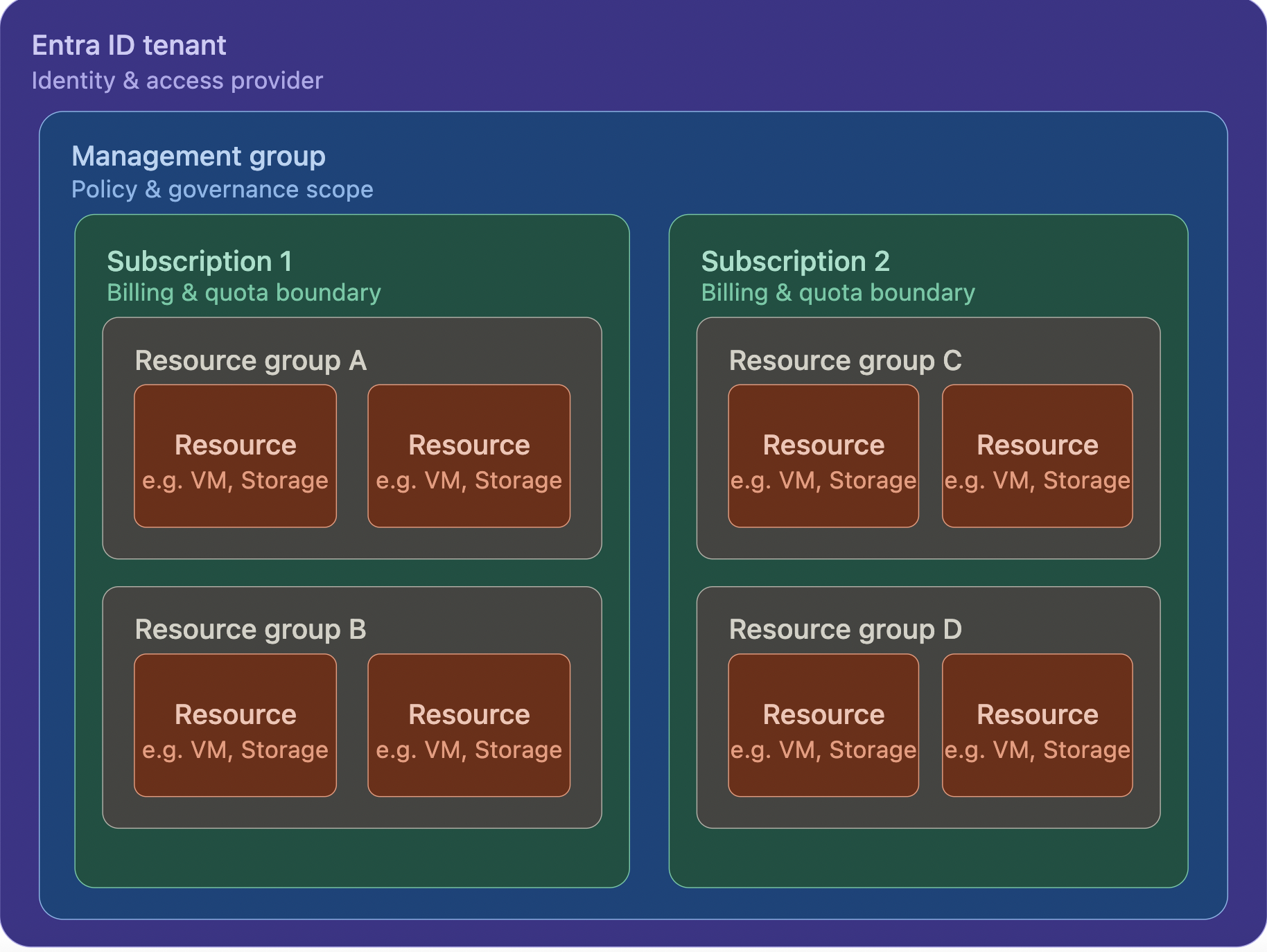
Hierarchy
We can simply understand it by following (Generated by Sonnet 4.6 xD):
RBAC
It likes IAM Roles of AWS but can be assign in multiple levels:
Management Group  →  inherit all belows
  └── Subscription  →  inherit all Resource Groups belows
        └── Resource Group  →  inherit all resources belows
              └── Resource  →  only that resource
Here are common built-in roles of Azure RBAC:
| Role | Permissions |
|---|---|
| Owner | Full access + assign roles |
| Contributor | Full access, without assign roles |
| Reader | View only |
| User Access Administrator | Manage access only |
Resource reference: https://learn.microsoft.com/en-us/azure/role-based-access-control/overview
Inheritance: very very very important, assigned 1 time in Management Group, all sub resource inherit.
Azure Policy vs IAM Policy
Totally different versus AWS IAM Policy. Azure Policy enforce rules on resources, not permissions.
| AWS | Azure |
|---|---|
| IAM Policy = who can do what | RBAC = who can do what |
| SCP = restrict accounts | Azure Policy = enforce rules on resources |
Example about Azure Policy:
- VM only created in Southeast Asia.
- Storage Account must enable encryption.
- All resources must have tag
Environment
Management Groups
Like AWS Organization, group Subscription for apply policies/RBAC
Root Management Group
  ├── Production
  │     ├── Subscription: prod-app1
  │     └── Subscription: prod-app2
  └── Development
        └── Subscription: dev-sandbox
Policy/RBAC assigned in Management Group, inherit to all subscription. Easy to understand, right?
Resource reference:
https://learn.microsoft.com/en-us/azure/governance/management-groups/overview
Little concept comparison
| Concept | AWS | Azure |
|---|---|---|
| Identity provider | IAM | Entra ID (Azure AD) |
| Permissions | IAM Policies | RBAC Role Assignments |
| Resource rules | Service Control Policies | Azure Policies |
| Account grouping | Organizations and Organization Units | Management Groups |
| Billing boundary | Account | Subscription |
| Resource grouping | Tags only | Resource Groups + Tags |
| Delete protection | Termination protection (EC2) | Resource Locks (any resource) |
Entra ID (Azure AD) vs AWS IAM
B2B: Business to Business
B2C: Business to Consumer
| Feature | AWS IAM | Entra ID |
|---|---|---|
| Built-in MFA | IAM MFA | Azure MFA (enforce via Conditional Access) |
| SSO to apps | IAM Identity Center | Enterprise Apps |
| B2B access | Cross-account roles | Guest Users |
| B2C access | Cognito | Azure AD B2C |
System-Assigned Managed Identity (SAMI) vs User-Assigned Managed Identity (UAMI)
Resource reference:
https://learn.microsoft.com/en-us/entra/identity/managed-identities-azure-resources/overview
| SAMI | UAMI | |
|---|---|---|
| Lifecycle | attach with resource, when delete resource, SAMI will be delete also | Don't care, still stay after resource deletion xD |
| Reuse | 1 resource → 1 identity | 1 identity → multiple resources |
| When | Throwaway, 1-1 with VM/App Service | Reuse identity between multiple resources |
Control Plane vs Data Plane
Subscription Owner
├── Control plane: create/delete/manage resource (Microsoft.Storage/*, Microsoft.KeyVault/*)
└── Data plane: No — must assign role explicitly
For example:
- Owner can create Storage Account
- Owner access blob (Binary Large Object) -> need role "Storage Blob Data Reader"
- Owner can create Key Vault
- Owner access secret -> need role "Key Vault Secrets User"
Resource Reference:
Managed Identity + Key Vault
Pattern:
App Service → [SAMI] → Key Vault Reference → Secret
Setup step:
- Enable SAMI in App Service
- Assign role Key Vault Secrets User for managed identity in Key Vault
- App setting uses
@Microsoft.KeyVault(SecretUri=...)
No need to store credentials anywhere, managed identity auto get token from Azure AD
K8s analogy: This pattern is identical to Workload Identity (AKS/GKE) or IRSA (EKS — IAM Roles for Service Accounts):
K8s:    Pod → [ServiceAccount] → IAM Role / Managed Identity → AWS/Azure resource
Azure:  App Service → [SAMI] → RBAC role → Key Vault secret
Same idea: workload is bound to an identity, the identity is granted permissions, and the runtime auto-exchanges tokens (via OIDC / IMDS endpoint). Code only calls the SDK — no secrets or keys needed anywhere. When Pod/App restarts, the identity persists — no manual credential rotation.
It also applies to in-cluster K8s RBAC: a Pod runs as a ServiceAccount, that SA is bound via Role/RoleBinding (or ClusterRole/ClusterRoleBinding), and calls to the K8s API server (default endpoint https://kubernetes.default.svc inside the Pod) are authenticated using the projected token at /var/run/secrets/kubernetes.io/serviceaccount/token. Same identity-binds-to-workload pattern, just scoped to the cluster instead of cloud resources.
Resource Reference:
- Use Key Vault references for App Service and Azure Functions
- How to use managed identities for App Service and Azure Functions
- Azure AD Workload Identity for AKS
Conclusion and Gotchas
- RBAC = IAM Roles.
- Azure Policy = Service Control Policies (but have more flexibility)
- SAMI is often prefer because it will not make
orphaned identitiesxD - Subscription owner can not read KV secret by default. Owner only have control plane permissions — need to self-grant data plane role (e.g.
Key Vault Secrets User) if access is needed - Key Vault Contributor = manage vault configuration (control plane), NOT read secret
- Key Vault Administrator = full data plane access (read/write/delete secrets, keys, certs)
- For vault access model best practice: pick RBAC!
Resource Reference:
Domain 2 - Compute
Virtual Machine (VM) Availability
| Availability Set | Availability Zones | VM Scale Sets (VMSS) | |
|---|---|---|---|
| Protection | Hardware/rack failure | Datacenter failure | Scale + HA |
| SLA | 99.95% | 99.99% | depend config |
| Use case | Legacy app, lift-and-shift | Production critical | Web tier, stateless |
| Region support | All region | Only region with zones | All region |
Exam Gotchas
- SLA 99.99% → must pick Zones, not Set
- Can not combine Availability Set and Availability Zones
- Availability Set: Fault Domain (FD): different physical rack (power, switch) — max 3, default 2
- Availability Set: Update Domain (UD): group VM not going to restart together when Azure patch — max 20
Resource Reference:
VM Encryption
| Type | What | When |
|---|---|---|
| SSE (Server-Side Encryption) | Azure auto encrypt in storage layer | Default |
| ADE (Azure Disk Encryption) | Encrypt OS + Data disks at OS level (BitLocker/DM-Crypt), key in Key Vault | Compliance required OS-level encryption |
Verdict: SSE almost ready for everything. ADE only when compliance is required.
Resource Reference:
- Overview of managed disk encryption options
- Server-side encryption of Azure Disk Storage
- Azure Disk Encryption for VMs and VMSS
Note: ADE is scheduled for retirement on September 15, 2028. Microsoft recommends migrating to encryption at host for new VMs.
Deployment slot
Azure App Service deployment slots are live, distinct environments for your web apps. They allow you to test changes, warm up instances, and achieve zero-downtime deployments. By managing configurations independently, you can deploy updates to a staging slot, verify them, and instantly swap them into production. (from AI Overview when google search xD).
Some note for exam:
- Deployment slot is not available in Free/Basic plan. If question related to staging environment, pick Standards.
- After slot swap, both slot still running, for rolling back, just simple by swap back.
- App Service Plan = compute resource.
Resource Reference:
ARM (Azure Resource Manager) and Bicep
- ARM Template = Cloudformation Template of AWS
- Bicep still is ARM but better syntax (Azure only)
- Still prefer to use Terraform instead of this fucking shit when it comes to production!
Containers
Comparison between 3 services
| Service | What | When |
|---|---|---|
| ACI (Azure Container Instances) | Run 1 container fast, no fucking cluster | Dev/test, batch jobs, CI/CD runners |
| Container Apps | Serverless containers with scaling (KEDA inside), ingress | Production apps, microservices |
| AKS | Managed Kubernetes | You know when.... |
Resource Reference:
Domain 3 - Storage
Azure Storage Account vs AWS S3 — Mental Model
AWS                              Azure
───────────────────────────────────────────────────
(No)                         →   Storage Account (wrap layer)
S3 Bucket                    →   Blob Container
S3 Object                    →   Blob
S3 Bucket Policy             →   Container Access Policy / RBAC
S3 Lifecycle Rules           →   Lifecycle Management
S3 Versioning                →   Blob Versioning
S3 Storage Classes           →   Access Tiers (Hot/Cool/Archive)
S3 Presigned URL             →   SAS Token
S3 Static Website            →   Static Website (in Blob)
───────────────────────────────────────────────────
EFS                          →   Azure Files
SQS                          →   Queue Storage
DynamoDB (simple use)        →   Table Storage
Key Differences:
| AWS | Azure |
|---|---|
| Create S3 bucket directly | Need to init Storage Account first, then create container |
| Each bucket have it owns settings | Storage Account contains setting for all services inside |
| Bucket name globally unique | Storage Account name globally unique, Blob container only need unique in internal Storage Account |
| Bucket policy per bucket | RBAC can be set at account or container level |
Example:
AWS:
  - s3://my-images-bucket        (Create)
  - s3://my-backup-bucket        (Create)
  - EFS: my-team-share           (Other service)

Azure:
  - mystorageaccount
      ├── container: images      (Like S3 bucket)
      ├── container: backups     (Like S3 bucket)
      └── fileshare: team-share  (Like EFS)
Immutable vs Mutable Settings
Can not change after created:
- Storage Account name
- Location/Region
- Performance tier (Standard ↔ Premium)
- Hierarchical namespace (For exam, but in fact we have migration tool)
Can be change after created:
- Redundancy (LRS/ZRS/GRS) - but limit
- Access tier (Hot/Cool)
- Network/Firewall rules
- Data protection (soft delete, versioning)
- Encryption settings
We need to pick Name, Region, Performance tier right for the first damn time!
Replication Types
In single region:
| Type | What | When |
|---|---|---|
| LRS (Locally Redundant) | 3 copies, 1 datacenter | Hardware failure |
| ZRS (Zone Redundant) | 3 copies, 3 zones | Datacenter / zone failure |
Cross-region:
| Type | What | When | Read from secondary? |
|---|---|---|---|
| GRS (Geo-Redundant) | 6 copies (3+3), 2 regions | Region failure | No, Never able to read from secondary, must failover first, after failover, secondary become new primary |
| RA-GRS (Read-Access GRS) | 6 copies, 2 regions | Region failure | Yes (always) |
| GZRS | ZRS primary + LRS secondary | Zone + region failure | No |
| RA-GZRS | ZRS primary + LRS secondary | Zone + region failure | Yes |
Pick replication by keyword:
| When | What |
|---|---|
| Disk/hardware failure, cheapest | LRS |
| Zone failure, within region | ZRS |
| Region down, data still available | GRS (If no continuously read) |
| Region down + can read secondary continuously | RA-GRS |
| Zone + region, highest availability | RA-GZRS |
| Available even if a region goes down and cost-effective | GRS |
Resource Reference:
- Azure Storage redundancy
- Change how a storage account is replicated
- Hot, cool, cold, and archive access tiers for blob data
- Grant limited access to data with shared access signatures (SAS)
Exam Tricks for Storage Features (non-replication)
For replication keywords (LRS/ZRS/GRS/RA-GRS/GZRS/RA-GZRS), see the Replication Types section above.
| When | What |
|---|---|
| Data cannot be deleted/modified for compliance | Immutable storage (WORM - Write once read many) |
| Automatically move old data to cheaper tier | Lifecycle Management Policy |
| Share files between VMs (SMB) | Azure Files |
| Store VM disk | Managed Disk (Premium SSD/Standard SSD/HDD) |
| Cheapest storage for rarely accessed archived data | Archive tier |
| Restore accidentally deleted blob | Soft Delete |
| Grant temp access to a specific blob without sharing key | SAS token |
Domain 4 - Networking
Resource Reference:
Quick Mapping from AWS VPC xD
AWS                              Azure
───────────────────────────────────────────────────
VPC                          →   VNet
Subnet                       →   Subnet
Security Group               →   NSG (Network Security Group)
Elastic IP                   →   Public IP (Static)
ENI                          →   NIC (Network Interface Card)
VPC Peering                  →   VNet Peering
NAT Gateway                  →   NAT Gateway
Route Table                  →   Route Table
But there is still some little different. And we will go one by one
Subnet and Availability Zones (AZs)
- AWS: each Subnet locked into 1 AZ. To achieve HA, we need to create multiple subnet in different AZ.
- Azure: Subnet expanded to all AZ in single region. We can place VM in AZ 1, AZ 2, AZ 3 into same subnet.
NSG (Network Security Group) vs SG (Security Group) / NACL
- AWS: Use SG (applied at ENI/Instance) and Network ACL (NACL) (applied at Subnet)
- Azure: Use only NSG. NSG Can be applied both to NIC or Subnet
- NSG is stateful, NACL is stateless
Stateful vs Stateless — what does it mean?
- Stateful (NSG, AWS SG): firewall remembers connections. When outbound traffic is allowed, the return traffic is automatically allowed — the firewall tracks the session in a connection table.
- Stateless (AWS NACL): firewall has no memory. Every packet is evaluated independently → you must define rules for both directions (inbound AND outbound).
Quick example — VM calling GitHub API (HTTPS port 443):
VM (random port 54321) ──[request]──→ GitHub (port 443)
VM (random port 54321) ←──[response]── GitHub (port 443)
| NSG (stateful) | NACL (stateless) | |
|---|---|---|
| Rules needed | 1 outbound: Allow TCP 443 | Outbound: Allow TCP 443 + Inbound: Allow TCP from 443 → ephemeral ports 1024-65535 |
| Forget the return rule? | Still works (auto-tracked) | Response dropped → connection fails |
That's why Azure only needs one NSG instead of AWS's two-layer SG + NACL model — simpler, no need to open wide ephemeral port ranges, less misconfiguration risk.
Resource Reference:
VNet Peering & Gateway
AWS                              Azure
───────────────────────────────────────────────────
VPC Peering (same region)    →   VNet Peering
VPC Peering (cross-region)   →   Global VNet Peering
VPN Gateway                  →   Virtual Network Gateway
Transit Gateway              →   Virtual WAN / VNet Gateway
Site-to-Site VPN             →   VPN Gateway Connection
Direct Connect               →   ExpressRoute
| When | What |
|---|---|
| Connect 2 VNets same region | VNet Peering |
| Connect 2 VNets different region | Global Peering |
| On-prem ↔ Azure (internet) | VPN Gateway |
| On-prem ↔ Azure (dedicated) | ExpressRoute |
Resource Reference:
Azure DNS
AWS                              Azure
───────────────────────────────────────────────────
Route53                      →   Azure DNS
Route53 Hosted Zone (public) →   Public DNS Zone
Route53 Private Hosted Zone  →   Private DNS Zone
Route53 Domain Registration  →   App Service Domain
Route53 Health Checks        →   Traffic Manager
Route53 Routing Policies     →   Traffic Manager
Azure separates health checks + traffic routings via Traffic Manager, not built-in like Route53.
Azure Load Balancing
AWS                              Azure
───────────────────────────────────────────────────
NLB (Layer 4)                →   Azure Load Balancer
ALB (Layer 7)                →   Application Gateway
CloudFront + ALB (global)    →   Azure Front Door
Route53 routing policies     →   Traffic Manager (DNS-based)
| Service | Layer | Use case |
|---|---|---|
| Load Balancer | L4 | VM load balancing, non-HTTP |
| Application Gateway | L7 | Web apps, SSL termination, WAF |
| Front Door | L7 Global | Global apps, CDN + LB + WAF |
| Traffic Manager | DNS | Failover, geo routing |
Resource Reference:
- Load-balancing options — Official Microsoft comparison
Azure Network Watcher (Debug tools)
AWS                              Azure
───────────────────────────────────────────────────
VPC Flow Logs                →   NSG Flow Logs
VPC Reachability Analyzer    →   IP Flow Verify / Connection Troubleshoot
VPC Traffic Mirroring        →   Packet Capture
Verdict: Almost 1:1 with AWS VPC/Route53/ELB, just a fucking name different.
Resource Reference:
Exam Gotchas
- ExpressRoute does not go via internet → question "secure private connection" = ExpressRoute.
- VPN Policy-based not support Point-to-Site.
- Active-Active VPN Gateway = 2 tunnel, high availability.
- ExpressRoute Global Reach: connect 2 on-prem sites via Azure backbone (no need internet).
- Question "consistent latency, high bandwidth" = ExpressRoute.
- Question "quick setup, cost-effective" = VPN Gateway.
Domain 5 - Monitor & Backup
Quick Mapping from AWS for Backup xD
AWS                              Azure
───────────────────────────────────────────────────
AWS Backup                   →   Azure Backup
Backup Vault                 →   Recovery Services Vault
AWS DRS / CloudEndure        →   Azure Site Recovery (ASR)
EBS Snapshots                →   VM Backup (disk snapshots)
Backup Services
| Service | What |
|---|---|
| Azure Backup | Backup VMs, databases, files (daily, point-in-time) |
| ASR (Azure Site Recovery) | Replicate VMs to another region, failover when DR |
Verdict: Azure Backup = AWS Backup, ASR = DRS (AWS Elastic Disaster Recovery).
Resource Reference:
Quick Mapping from AWS CloudWatch
AWS                              Azure
───────────────────────────────────────────────────
CloudWatch                   →   Azure Monitor
CloudWatch Metrics           →   Metrics
CloudWatch Logs              →   Log Analytics Workspace
CloudWatch Logs Insights     →   Kusto Query Language (KQL)
CloudWatch Alarms            →   Alerts
CloudWatch Agent             →   Azure Monitor Agent
X-Ray                        →   Application Insights
Resource Reference:
Exam Tip/Tricks
Summary of common pitfalls, this is not study guide. Only pattern to drop wrong answer xD
1. "X replaces NSG/Firewall"
This is always wrong. Bastion, Private Endpoint, VPN Gateway, Front Door, App Gateway... not replace NSG. NSG is layer filter , always apply together.
2. VNet Peering
| Trap | Correct |
|---|---|
| Peering is transitive | Wrong — A↔B, B↔C does not imply A↔C |
Enable Use Remote Gateway in 1 side is enough |
Wrong, must be paired with Allow Gateway Transit with gateway side |
| 1 spoke use multiple remote gateway | Wrong — only one |
3. Storage Replication
See Domain 3 — Replication Types for the full picker table.
Pitfalls: "highest availability within a region" → ZRS (not GRS). GRS is cross-region. G stands for GEO
4. Backup vs Site Recovery
- Azure Backup = data recovery (file, VM disk, DB) — RPO calculate by hour/day
- Azure Site Recovery (ASR) = disaster recovery (replicate VM into another region) — RPO/RTO low
Question "recover deleted file" → Azure Backup. "Region down, switch to another region" → ASR.
5. Recovery Services vault vs Backup vault (naming pitfall )
| Vault | Workload |
|---|---|
| Recovery Services vault (Old) | Azure VM, MARS agent (files/folders/system state on-prem), SQL/SAP HANA in VM, Azure File Shares |
| Azure Backup vault (New) | PostgreSQL, Blob, Managed Disks, AKS, MySQL |
Keyword "files, folders, system state" → alway are Recovery Services vault (Because attach with MARS agent). Don't be wrong with "Azure Backup vault"
Resource Reference:
6. RBAC vs Azure Policy
- RBAC = who did what (access)
- Policy = resource allows to exist or not (compliance, deny tag missing, deny SKU ...)
If questions are "enforce tag", "block region" → Policy. Otherwise "grant read access" → RBAC.
7. Four built-in roles
| Role | Manage resources | Assign roles |
|---|---|---|
| Owner | Ok | Ok |
| Contributor | Ok | Hell no |
| Reader | No (read-only) | No |
| User Access Administrator | No | Ok |
Common pitfalls: exam question "full manage resources but no assign roles" → answer is Contributor, NOT User Access Administrator (UAA). UAA is reversed role — Only assign roles, not going to have permissions to touch resources.
Trick:
- Owner = Contributor + UAA
- Contributor = Everything but not able to give permissions
- UAA = Only able to give permissions
8. RBAC scope — 4 levels
Management Group  (top, contains multiple subscription)
    ↓ inherit
Subscription
    ↓ inherit
Resource Group
    ↓ inherit
Resource          ← VNet, VM, Storage, Key Vault... individual resource.
Rules: Anything that contains Resource ID can be scope. Role assigned at higher scope, inherit to lower scope.
Pitfalls: List specific like "Virtual Network", "Storage Account" make distractor, it still is valid scope (Level Resource).
Least privilege pattern: Instead assign Contributor at Subscription, assign role lower scope, like Network Contributor at that damn Virtual Network.
9. Locks
| Lock | what Lock |
|---|---|
| ReadOnly | Both modify + delete |
| CanNotDelete | only delete, still able to modify |
Gotcha: ReadOnly lock can break some operations thought it was "read".
Example: list keys of Storage Account actually is post request.
Resource Reference:
10. Cost Management Pitfalls
- Reserved Instance = commit 1/3 year, reduced up to 72%
- Spot VM = cheap but can be evicted
- Hybrid Benefit = bring license Windows/SQL on-prem to Azure
If question "predictable workload, lowest cost" → Reserved Instance. "Batch job, can be restart" → Spot.
Resource Reference:
11. An overly absolute answer → 90% chance of being a distractor
"red flag" in answers xD:
| Red flag | Why |
|---|---|
automatically |
Azure rare do for user — license, scaling, backup... all need config |
all / every |
All PaaS services, every VM in subscription —> Azure doesn't apply blanket |
only |
Each user can have only one license, only via portal — Azure normally can have multiple ways |
never / cannot |
Azure dynamic, Absolute prohibitions are rare |
replaces |
Service A "replaces" Service B → mostly they are individual layer |
12. Network Watcher — choose the right tool
| What | Tool |
|---|---|
| latency / packet loss VM↔VM | Connection Monitor |
| Test 1 time: VM A can connect to VM B port X? | Connection Troubleshoot |
| This Packet would dropped by NSG or not? | IP Flow Verify |
| Effective NSG rules applied NIC | Effective Security Rules |
| Log all traffic via NSG | NSG Flow Logs |
| Draw network topology | Topology |
| Capture packet to analyze Wireshark | Packet Capture |
Need to remember:
- If question "between two VMs" + "network" → reflex Network Watcher.
- If question "continuous/monitor over time" → Connection Monitor.
- If question "one-time test" → Connection Troubleshoot.
13. Azure Monitor — Metrics vs Logs vs Insights
Pitfalls: exam ask "diagnostic between 2 specific VM" → Hell No, it is NOT Insights. Insights is overview, not deep-dive.
Differentiation Insights vs Log Analytics when exam have "analyze":
| Exam | Pick |
|---|---|
| view dashboard / performance overview / dependency map | Insights |
| analyze / query / compliance report | Log Analytics |
| across multiple VMs + summary data | Log Analytics |
| Update Management / patch compliance | Log Analytics (data put into workspace) |
| Change tracking | Log Analytics |
14. Private DNS + Private Endpoint + Hybrid resolution
Questions around "Can VM/on-prem resolve name of private or not?". Need to remember scope of each components.
| Component | Scope | Note |
|---|---|---|
| Private DNS Zone | Global | 1 zone link, multiple VNet in every region/sub |
| VNet | Region | No cross-region |
| VNet Peering | Cross-region/cross-sub OK | Not share DNS by default |
| DNS Private Resolver (inbound/outbound endpoint) | Region | HA need resolver for each region |
| Private Endpoint NIC | Region (in subnet) |
Pitfall 1: Peering not share DNS
-
VNet-A have Private Endpoint + zone already link → VM-A resolve OK. VM-B in VNet-B (peered) fail because zone haven't link to VNet-B.
-
Fix: link zone to both VNet. Zone is global, link is unlimit
Pitfall 2: Hybrid DNS need Private Resolver
- On-prem need to resolve
mystorage.privatelink.blob...→
On-prem DNS  ──conditional fwd──→  DNS Private Resolver
                                   (inbound endpoint, region X)
                                          ↓
                                   linked Private DNS Zones
                                          ↓
                                   return IP private endpoint
- Inbound endpoint = on-prem DNS forward query into Azure (resolve privatelink zones)
- Outbound endpoint = Azure VM resolve DNS on-prem via conditional forwarding rules.
- HA cross-region → deploy resolver in 2 region
Common Scenario:
| Symptoms | Reason | Fix |
|---|---|---|
| VM resolve private endpoint → public IP | Zone haven't link VNet | Link zone into VNet |
| Spoke not resolve even peered hub | Zone link only hub | Link zone into spoke also |
| On-prem resolve → public IP | Don't have hybrid DNS | Deploy DNS Private Resolver + conditional fwd |
| HA cross-region hybrid | Resolver region-bound | Resolver in 2 region |
| Zone in different sub without link | Cross-sub permission | Provide Network Contributor for zone |
Resource Reference: